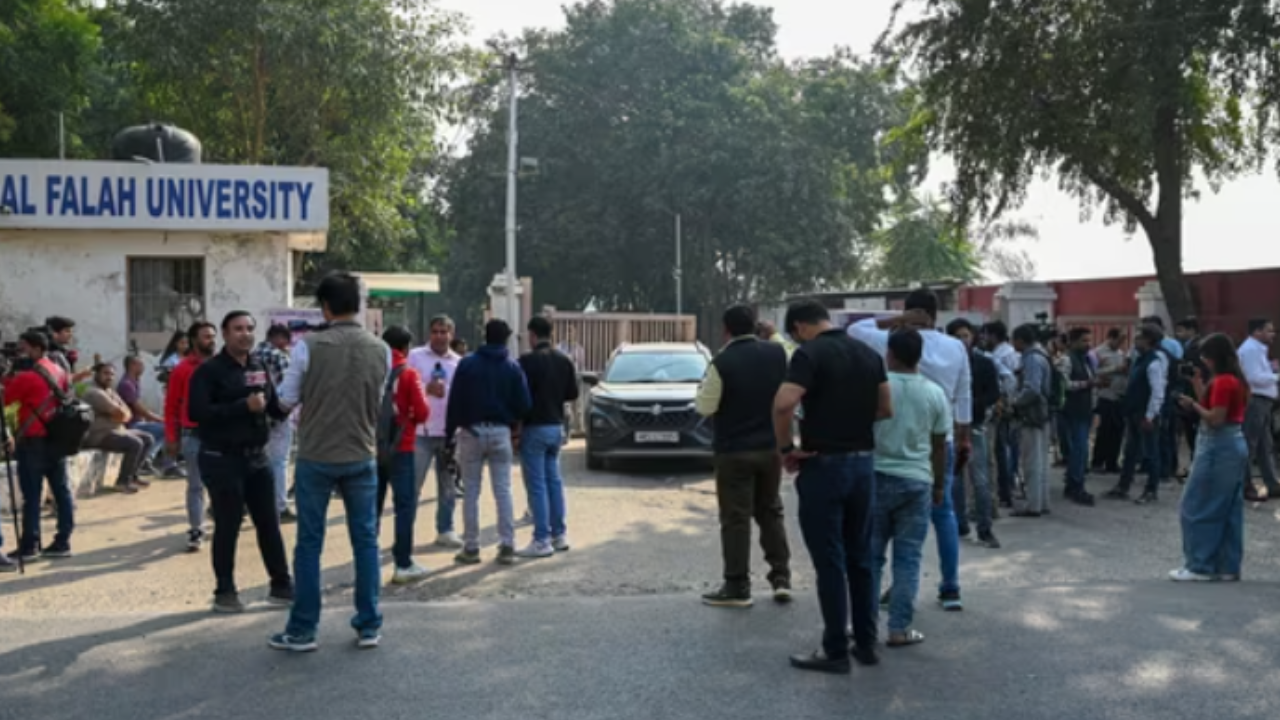
A major recovery of explosives in Faridabad and the deadly blast near Delhi’s historic Red Fort — which claimed more than ten lives last week — have put Haryana-based Al Falah University under serious national scrutiny. What initially began as an investigation into an explosives seizure has now widened into a complex probe involving financial misconduct, misleading accreditation claims, and alleged connections of certain faculty members with suspects in the recent Delhi car explosion case.
Explosives Seizure from Al Falah University
The chain of events began when security agencies discovered a large stockpile of explosives inside a rented residence in Dauj village, Faridabad. The house belonged to Dr. Muzammil Shakil, a Kashmir-born medical professional who was associated with Al Falah University. Soon after, investigators linked Dr. Umar Un Nabi, suspected to be the suicide bomber driving the explosive-filled car near Red Fort, to the same university. Several of the individuals arrested in connection with the attack reportedly share academic or professional ties with the institution.
This unexpected link prompted probe agencies to question the university’s top leadership. Investigators summoned Jawad Ahmad Siddiqui, chairman of the Al Falah group, stating that his testimony was essential to address several inconsistencies related to the university’s operations, staff activities, and internal functioning.
Allegations of Fake Accreditation and Misleading Claims
Alongside the terror-related investigation, Al Falah University is also being accused of falsely advertising NAAC accreditation, thereby deceiving students, parents, and other stakeholders. According to probe officers, the institution allegedly misused NAAC claims to gain financial benefits and attract admissions under fraudulent pretenses.
On Tuesday, the Enforcement Directorate (ED) formally arrested Chairman Jawad Ahmad Siddiqui under Section 19 of the Prevention of Money Laundering Act (PMLA) 2002. The arrest followed extensive searches conducted at several locations linked to the Al Falah group as part of an Enforcement Case Information Report (ECIR) into suspected financial wrongdoing.
Financial Misconduct and Large-Scale Diversion of Funds
The ED initiated its probe on the basis of two FIRs lodged by the Delhi Police Crime Branch. These FIRs accused the university of making deceptive claims about NAAC accreditation and raised concerns about irregularities in its financial statements.
According to an ED spokesperson, investigators uncovered evidence indicating that substantial “proceeds of crime” amounting to crores of rupees were generated and diverted through various channels. ED officials claim that multiple transactions show funds being channeled from the university’s trust into entities owned or controlled by Siddiqui’s family members.
A senior ED officer explained that the Al Falah Trust, founded in 1995, witnessed extensive expansion under Siddiqui’s leadership from the late 1990s onward. Despite the rapid growth of the educational group — which includes colleges, universities, and associated services — its officially recorded finances did not justify such expansion. Officials believe that family-run companies played a central role in questionable payments and contracts.
Cash Seized, Shell Companies Under Scanner
During raids conducted at Siddiqui’s residence and offices, the ED confiscated ₹48 lakh in cash, along with electronic devices, financial papers, and other documents. Early findings suggest that contracts for construction, catering, and various services were routinely granted to companies linked to Siddiqui’s wife and children.
Officials also identified nine suspicious companies, all registered at the same address, which are now a prime focus of investigation. According to ED sources, these firms exhibit typical characteristics of shell companies — no real business activity, shared contact details, identical directors, and minimal operational resources. Many of them reportedly received payments from the Al Falah Trust without proper justification or documentation.
Irregular Salary Payments and Missing Statutory Filings
Another concerning discovery from the raids was that salary transactions were poorly documented, with little to no evidence of proper payroll systems. Basic compliance requirements such as EPFO (Employees’ Provident Fund Organisation) and ESIC (Employees’ State Insurance Corporation) filings were allegedly not found at any of the searched locations, raising doubts about whether employees were genuinely being compensated or whether funds were being misrepresented.